Home
Home Search
 Contact


Other research areas covered by the program
While the focus of the program is flatback turtles of the North West Shelf, researchers also collaborate or conduct research on other marine turtle species, policy and management relevant to marine turtles, and enlist the help of Traditional Custodians to guide the planning of regional co-management.
Click here to view a full list of peer-reviewed research from the North West Shelf Flatback Turtle Conservation Program.

Research on the biology of other marine turtle species include using skin biopsies to predict the age of green turtles, developing a minimally invasive method to identify the sex of adult green turtles, and an investigation into the levels of multiple paternity of loggerhead turtles in Western Australia. Staff have also collaborated in the development of a model that allows automated, rapid, and reliable quality control of animal’s tracking data, which can be used to inform the management of human activities in important areas for marine species in near real-time.
All species of marine turtles across Western Australia face similar threats. Understanding some of these impacts on other turtle species can indicate the effect on flatback turtles. The NWSFTCP has conducted research to quantify the predation of eggs and hatchlings of loggerhead turtles, the thermal stress in loggerhead turtle embryos, a simulation of the growth and reproduction of green turtles under climate change scenarios, and the identification of future conservation areas for multiple species of marine turtles.
Staff from the NWSFTCP have collaborated and advised on frameworks for conservation of marine turtles, methods for translating marine animal tracking data into conservation policy and management, research needs for the remote Kimberley region of Western Australia and defining ethical operational thresholds for drones.
Traditional Custodians in the remote Kimberley region of Western Australia have collaborated with researchers to understand where marine turtles nest along the coastline. Aerial surveys were complemented with ground surveys completed by multiple Traditional Custodian groups trained by NWSFTCP staff. Traditional Ecological Knowledge proved vital to verify harder to detect species with irregular nesting, such as hawksbill and olive ridley turtles.
Through this collaboration, the boundaries of summer and winter flatback turtle genetic populations were identified, as well as confirmation that green turtles nest year-round. Remote islands generally had higher nesting efforts and fewer terrestrial predators recorded. These outcomes have been used to guide regional co-management planning, undertaken by Aboriginal Ranger groups.
This research was conducted in collaboration with multiple Traditional Custodian groups (refer to the ‘Working with Traditional Custodians’ page for more information), Western Australia Marine Science Institution, Pendoley Environmental, and the Indigenous Saltwater Advisory Group Program.
Some examples of the Program's other research
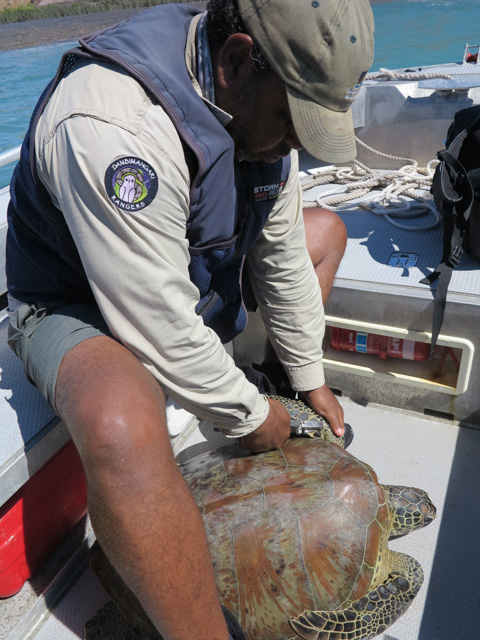
Dambimangari ranger Adrian Lane tagging a green turtle in 2017. Photo - DBCA
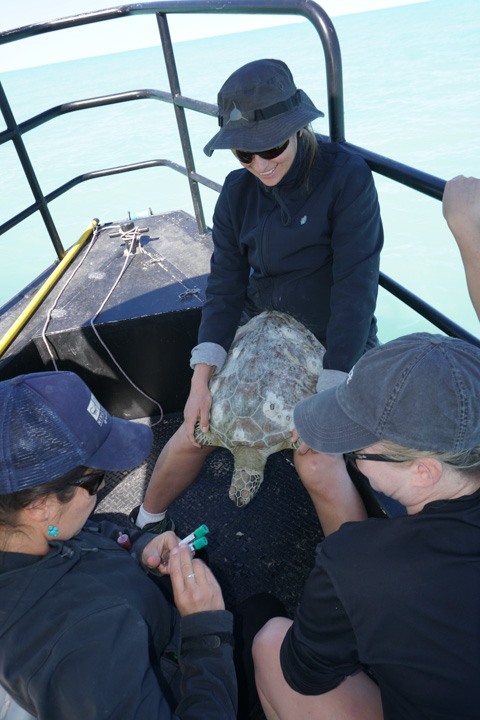
Collecting a green turtle in Yawuru Nagulagun Roebuck Bay. Photo - DBCA
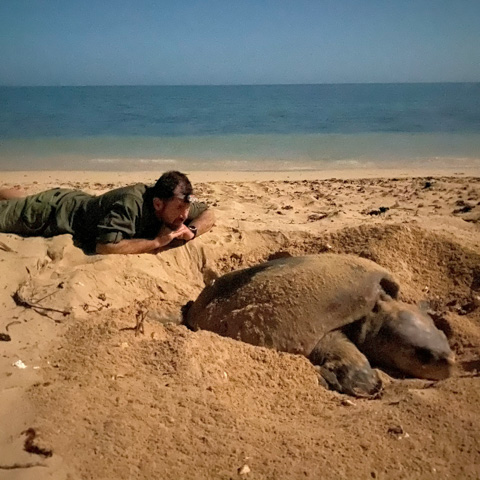
Casper Avenant watching a loggerhead turtle lay eggs while studying predation rates. Photo - DBCA
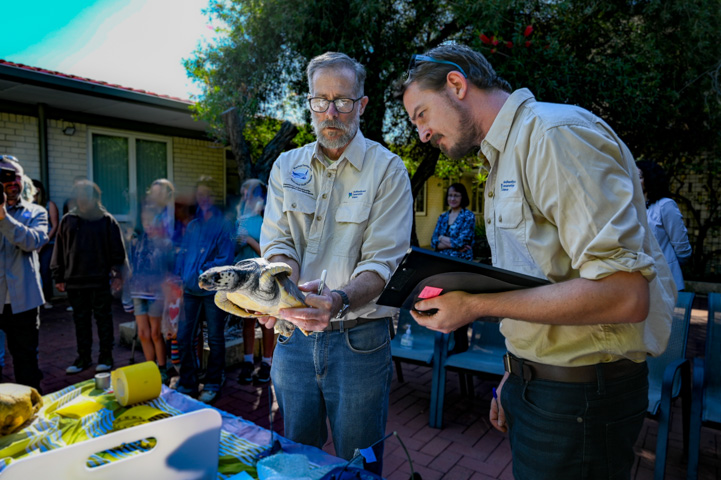
NWSFTCP team preparing a loggerhead sub-adult for release after rehabilitation in 2018. Photo - Ryan Douglas/DBCA.
Researchers
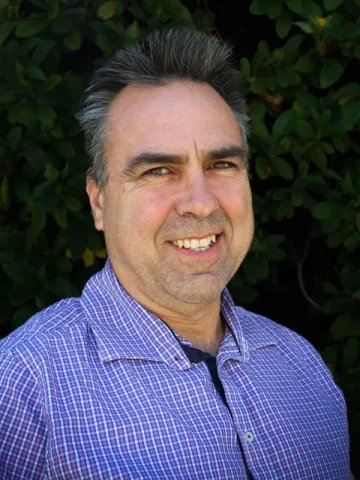
Dr Scott Whiting
Principal Research Scientist
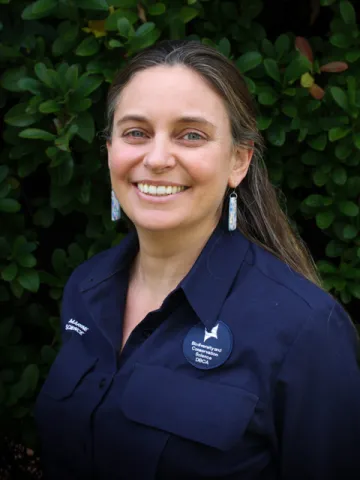
Dr Sabrina Fossette
Senior Research Scientist

Dr Tony Tucker
Senior Research Scientist