
 Home
Home Search
 Contact


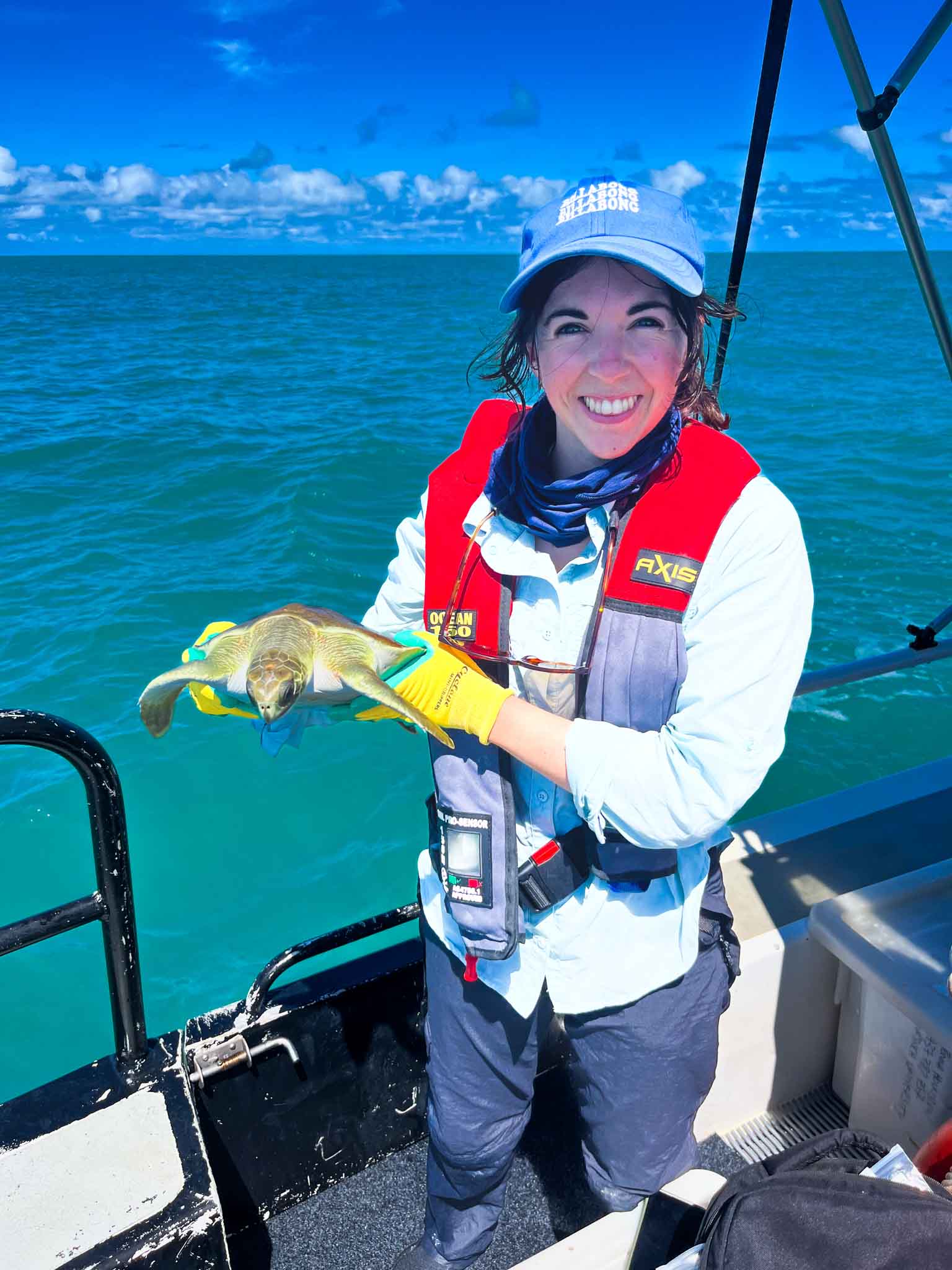
Rosie Brown
PhD candidate - Murdoch University
Rosie began her PhD in October 2023 and is expecting to complete her research by the end of 2027. With a Master's degree in Zoology from the University of Exeter, field experience working in Cyprus for the Society for the Protection of Marine Turtles (SPOT) and three years at the Olive Ridley Project, Rosie is well equipped to explore the environmental drivers of diet, nutritional status and habitat use of the foraging population of flatback turtles at Yawuru Nagulagun Roebuck Bay.
The specific objectives of this study are to:
- Describe the foraging population and their breeding dynamics (including adult sex ratio, migration timing, distance travelled during migration, and frequency of breeding).
- Review established and emerging methods for assessing the nutritional status of marine turtles.
- Assess how environmental variables influence the foraging ecology of adult flatback turtles, including dietary patterns, foraging behaviour and subsequent nutritional status
Rosie’s project is a collaboration between Murdoch University’s Harry Butler Institute where she is supervised by Dr Adrian Gleiss, Dr Jenna Hounslow and Dr Karina Jones; the North West Shelf Flatback Turtle Conservation Program (NWSFTCP) where she is supervised by Dr Sabrina Fossette; DBCA Broome where she works alongside Yawuru DBCA rangers, and Nyamba Buru Yawuru (NBY) where she works alongside Yawuru Country Managers.
Rosie’s PhD is also supported by two years of Holsworth Wildlife Research Endowment, granted by the Ecological Society of Australia, and the John Glover Research Support Grant, granted by the Royal Society of Western Australia.
“I feel incredibly fortunate to study such an elusive species of marine turtle. There's still so much to unveil about flatback turtles, particularly in terms of their foraging grounds and how this influences breeding ecology. I'm excited to uncover new insights in the next few years and add another piece to the puzzle in their protection.” - Rosie Brown
Project activities
- To assess diet: stable isotope analysis (of blood and skin samples) and eDNA (from cloacal and buccal swabs).
- To assess nutritional status: body condition scoring (visual method), body condition index (morphometric index), ultrasonography (to measure fat depth and determine reproductive status) and bioelectrical impedance analysis (a tool for assessing body composition).
- To assess foraging behaviour: biologging (using CATS cameras and daily diaries).
Rosie in the field
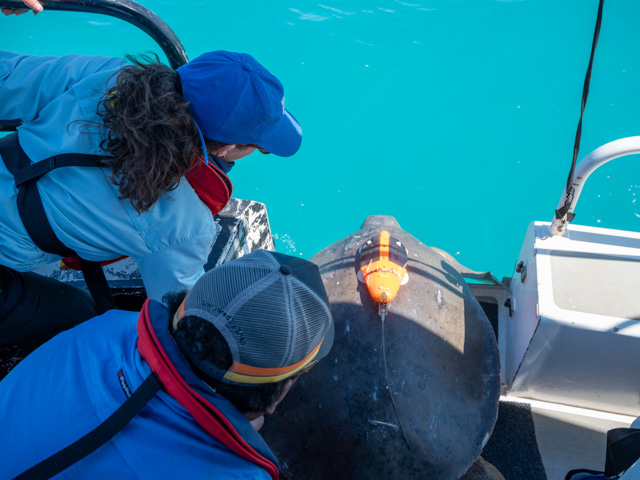
Rosie and NBY Country Manager Ron releasing a flatback turtle with a CATS cam on its shell. Photo - Tristan Simpson, DBCA
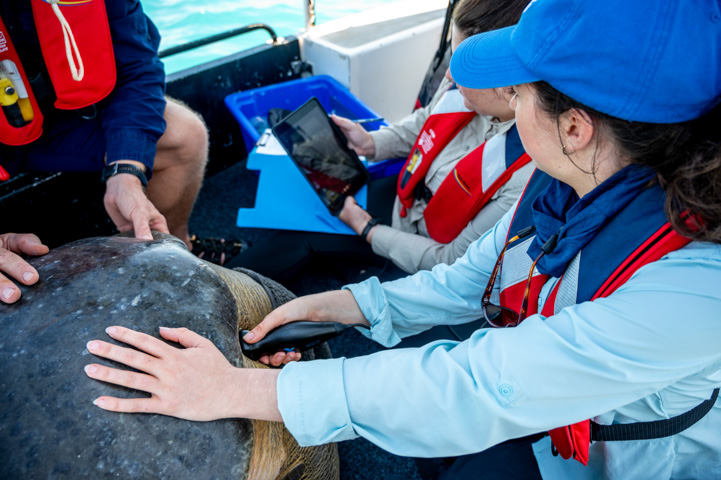
Rosie and Dr Karina Jones conducting ultrasonography on a flatback turtle to determine fat content. Photo - Tristan Simpson, DBCA
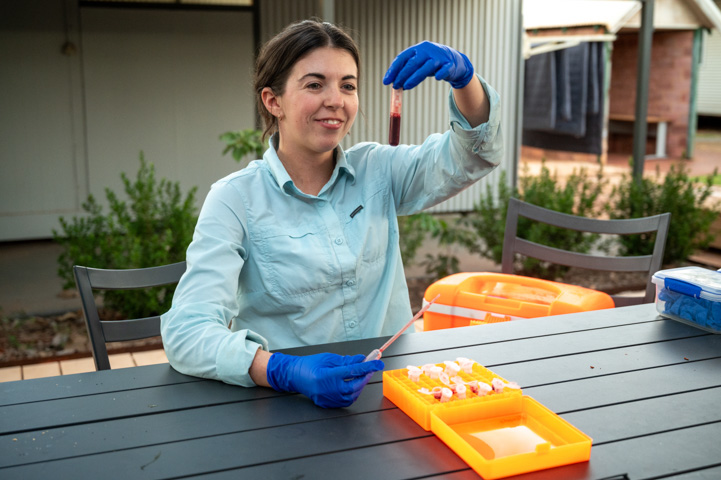
Rosie preparing blood samples taken from a flatback turtle. Photo - Tristan Simpson, DBCA

Rosie retrieving a CATS tag from Roebuck Bay using a VHF retriever. Photo - Tristan Simpson, DBCA

Rosie, Dr Karina Jones and ranger G collecting a flatback turtle from Yawuru Nagulagun Roebuck Bay. Photo - Tristan Simpson, DBCA
Acknowledgement of Country
The Government of Western Australia acknowledges the traditional owners throughout Western Australia and their continuing connection to the land, waters and community. We pay our respects to all members of the Aboriginal communities and their cultures; and to Elders both past and present.