Home
Home Search
 Contact


Taking students into the field
The North West Shelf Flatback Turtle Conservation Program provides opportunities to a small number of school groups each year to engage in turtle monitoring and conservation on Thevenard Island and Delambre Island with our scientists and volunteers.
Opportunities available
Turtle monitoring is conducted annually for five weeks from mid-November on Thevenard Island and Delambre Island off the Pilbara coast. This involves collecting data on turtle populations through capture-mark-recapture techniques (flipper and PIT tagging), understanding more about turtle biology and health through observations and measurements, and calculating hatchling emergence and survival through nest excavations.
The Program’s science team and groups of volunteers conduct the monitoring, with the help of student groups from schools. This is an excellent experience for students in real-world, applied science and data collection. Local schools and programs for Aboriginal students are prioritised, ensuring there are opportunities for young people to connect with their Sea Country and engage in conservation within their community. However, there are opportunities for schools with Bush Rangers or specialist programs from further afield to also participate.
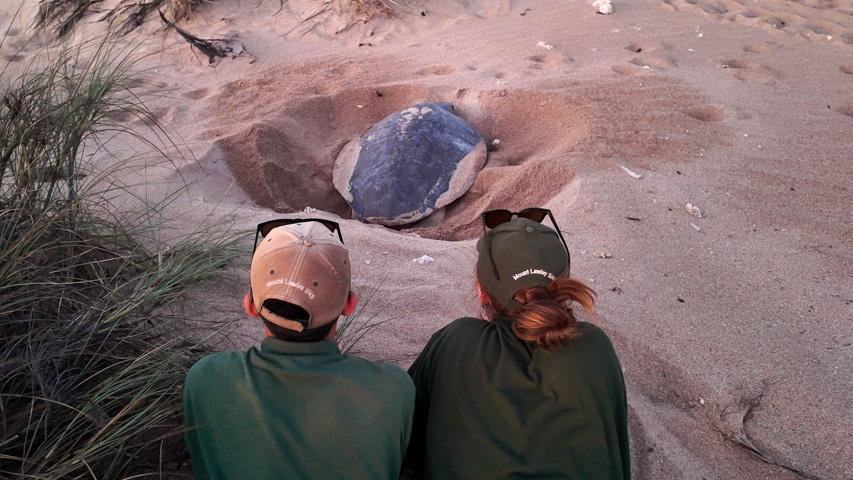
Bush Rangers getting up close and personal with turtles
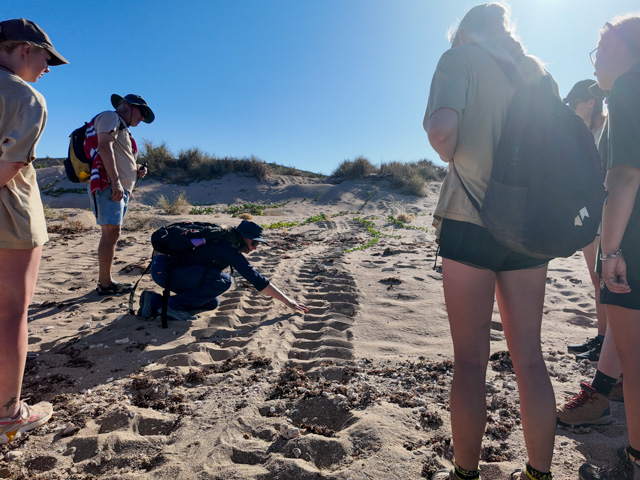
Mount Lawley Senior High School Bush Rangers experienced turtle nesting at close quarters on Thevenard Island, watching flatbacks lay their eggs over four nights in November 2023. The Bush Rangers engaged in turtle monitoring activities with the Program scientists, including identifying turtles from their flipper and PIT tags, taking carapace measurements, counting tracks and excavating nests.
“The look on their faces (seeing a turtle for the first time), it almost brings a tear to your eye. It’s an experience they will probably never see again, and never dreamed of having.” - Andrew Paul, Bush Rangers Cadet Unit Leader
Photo - Clodagh Guildea, DBCA
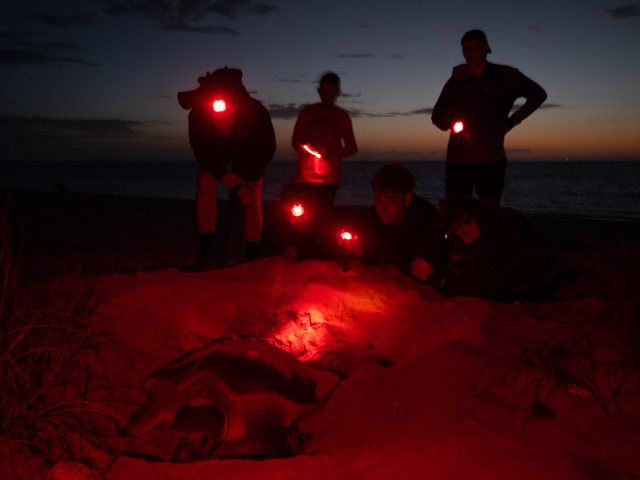
Clontarf Foundation students from Karratha Senior High School watched a flatback turtle lay her eggs on Delambre Island, where they followed the Turtle Watching Code of Conduct by waiting until she was laying before approaching and using only red lights. Photo - Tristan Simpson/DBCA
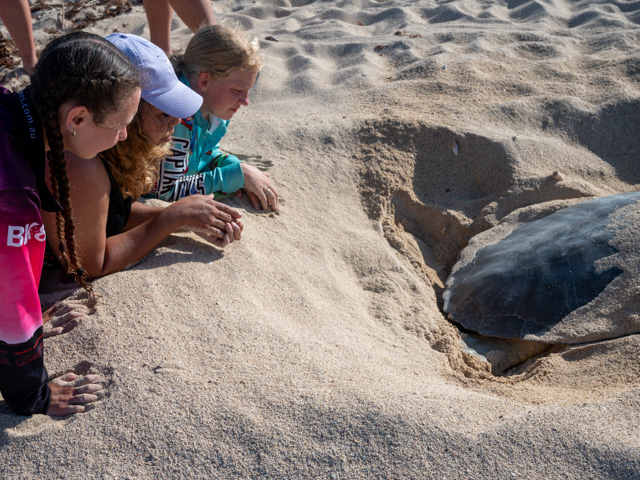
STARS Foundation students from Karratha Senior High School enjoyed seeing a flatback turtle lay her eggs during the daytime on Delambre Island, where they watched closely and counted each egg as it fell into the egg chamber below. Photo - Tristan Simpson/DBCA

Frequently asked questions

The North West Shelf Flatback Turtle Conservation Program runs two annual monitoring sites at Thevenard Island (off the coast of Onslow) and Delambre Island (off the coast of Karratha). There are opportunities to engage in turtle monitoring at mainland sites with other programs, such as the West Pilbara Turtle Program at beaches near Karratha, the Ningaloo Turtle Program at beaches around Exmouth, and Broome Parks and Wildlife Service at Cable Beach.
The length of field monitoring with school groups depends on the monitoring site visited. Fatigue management is also important to consider, as monitoring may be conducted for several hours during the night, depending on the tides.
On Delambre Island there is no infrastructure, so students sleep in provided tents (two per tent), use camp toilets and it can be very hot. For this reason, camps are limited to one or two nights depending on age group.
On Thevenard Island, student groups are accommodated in air-conditioned cabins equipped with bathrooms and kitchens. Camps can be up to four nights duration here, depending on age group and tides.
A member of the Program’s core team will be with your group for the entire field monitoring experience. This will either be the Science Communication and Education Officer, the Senior Environmental Scientist or a Research Scientist.
These staff all have Working With Children Checks and police clearances. Note that there will also be between six to ten adults volunteering with the Program on each island at any time, who may not have a Working With Children Check. They will not be interacting with students unsupervised and will be living in separate areas from students.
The cost of field monitoring with a school group depends on the monitoring site, locality of the school, number of students and the type of transport required.
To discuss the opportunity for turtle field monitoring with your students, please complete the Enquiry Form using the link at the bottom of this page. It will help if you can indicate the location you are coming from and are interested in going to, approximate number of students, and if these students are from a specialty program related to marine conservation at your school.