Home
Home Search
 Contact


Genetics of flatbacks informs conservation management
Genetics, or the study of genes, variation, and heredity, is an important tool for understanding the unseen elements of flatback turtles’ lives. Genetic studies provide insights into stock dynamics, critical habitat, migratory and mating behaviour and enable the design of effective management strategies for individual stocks of flatback turtles.
What we know so far
Genetic research within the program has so far been used to investigate three key topics – the number and boundaries of genetic stocks of flatback turtles across Australia, the lifespan of marine turtles, and the large-scale distribution of marine reptiles.
The research has shown there are seven distinct genetic stocks (or management units) of flatback turtles within Northern Australia, including the North West Shelf stock that is the focus of the NWSFTCP. The lifespan of flatback turtles has been estimated at approximately 50 years using CpG density. A single water sample can be used to identify the presence of multiple reptile species suggesting eDNA is a useful broadscale bioassessment tool. The NWSFTCP is investigating further uses of the ever-evolving field of genetics for flatback turtle conservation (e.g. close-kin genetics).
Research highlights

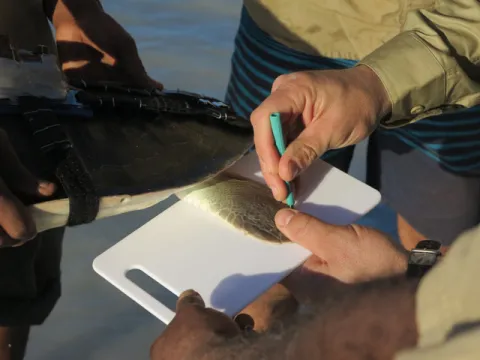
The use of environmental DNA (eDNA) has been explored as a sensitive, cost-effective and non-invasive solution to the lack of data surrounding the distribution of aquatic and semi-aquatic reptiles in Northern Australia (including flatback turtles). The primary purpose of this study was to design a metabarcoding assay (a technique that allows for simultaneous identification of many species within a single sample) for reptile groups in Northern Australia, and then test this on water samples collected from Broome (WA) and Cooktown (QLD).
Nine reptile species were detected from 10 of the 16 sampled sites, however there were instances where species were observed but did not show up in the sample. This shows that more research is required to assess the reliability, strengths and limitations of this method before it can be integrated as a broad scale bioassessment tool. With further research to refine the process, this shows promise for an accessible way to gather distribution data for flatback turtles and other reptiles in the future.
This research was led by Curtin University, in collaboration with DBCA/NWSFTCP and the Environmental Protection Authority Wellington.
By examining the difference in mitochondrial DNA and microsatellite loci between 17 flatback turtle rookeries across Northern Australia, researchers were able to identify seven designated genetic stocks (or management units). The identification of these genetic stocks has made it easier to quantify threats that are specific to a stock, whether along migratory routes or at foraging habitats, as well as assisting with the management of climate change implications that may be stock-specific.
This research was led by Griffith University, in collaboration with DBCA/NWSFTCP, University of Canberra, Charles Darwin University, Aalborg University, James Cook University, Kakadu National Park, Questacon National Science and Technology Centre, Southern Cross University, NSW National Parks and Wildlife Service, Department of Environment and Science QLD, Vancouver Fraser Port Authority, Australian National University, Conservation Volunteers Australia, Central Queensland University, Pendoley Environmental, University of Queensland, University of Koblenz-Landau, and Imbricata Environmental.
Understanding the lifespan of marine turtles has broad applications in marine turtle research, such as better understanding their life cycles and determining the long-term viability of stocks. However, it is exceptionally difficult to estimate due to their high juvenile mortality rates, their migratory behaviour, the difficulty of keeping turtles in captivity, and their longevity; they often outlive researchers. While skeletochronology (counting the rings in turtle bones, like you would with a tree) can be used to determine age, this can only be used for deceased individuals and is technically challenging.
Researchers invented a novel approach to determining how long animals live by measuring the density of certain motifs called CpG sites in their DNA sequences. Cytosine-phosphate-guanine (CpG) sites are where C and G nucleotides occur together. This remarkable biomarker system means that simply by reading an animals genome we can uncover fundamental information about its biology. The team used this approach to predict the lifespan of five marine turtle species and estimated that flatback turtles have a lifespan of approximately 50.4 years.
This research was led by CSIRO in collaboration with DBCA/NWSFTCP and The University of Western Australia.
Publications
Researchers
Dr Scott Whiting
Principal Research Scientist
Dr Sabrina Fossette
Senior Research Scientist

Dr Tony Tucker
Senior Research Scientist