Home
Home Search
 Contact


Identification and conservation of rookeries
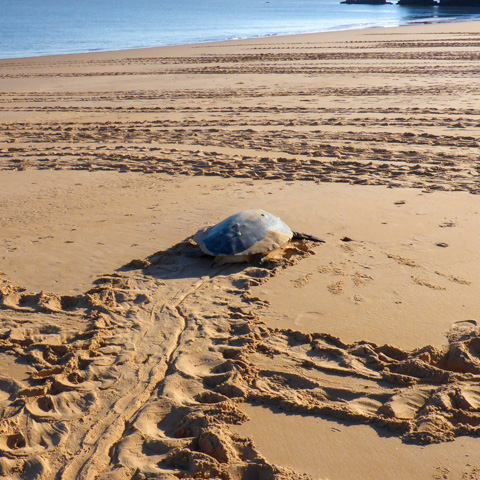
Female flatback turtles won’t just nest anywhere – after migrating to foraging areas, they return every two to three years to lay their eggs at a rookery (nesting beach) close to where they were born. The identification and protection of rookeries is critical for the future of the North West Shelf flatback turtle stock, which nest at rookeries ranging from Exmouth Gulf in the south to the start of Eighty Mile beach in the north.
What we know so far
The NWSFTCP is interested in answering the following questions; what current and future pressures and associated threats are acting on flatback turtle rookeries, and where should conservation be targeted to effectively protect the North West Shelf flatback turtle stock?
To answer these questions, aerial surveys have been used to identify beaches with turtle tracks to estimate flatback turtle distribution and abundance. To assess the impact of pressures on these locations, the overlap of rookeries, protected areas, industrial pressures, and modelled risks from priority threats, including erosion, sea level inundation and temperature increase risks have been modelled. This information is vital for informing future conservation management decisions across the North West Shelf.
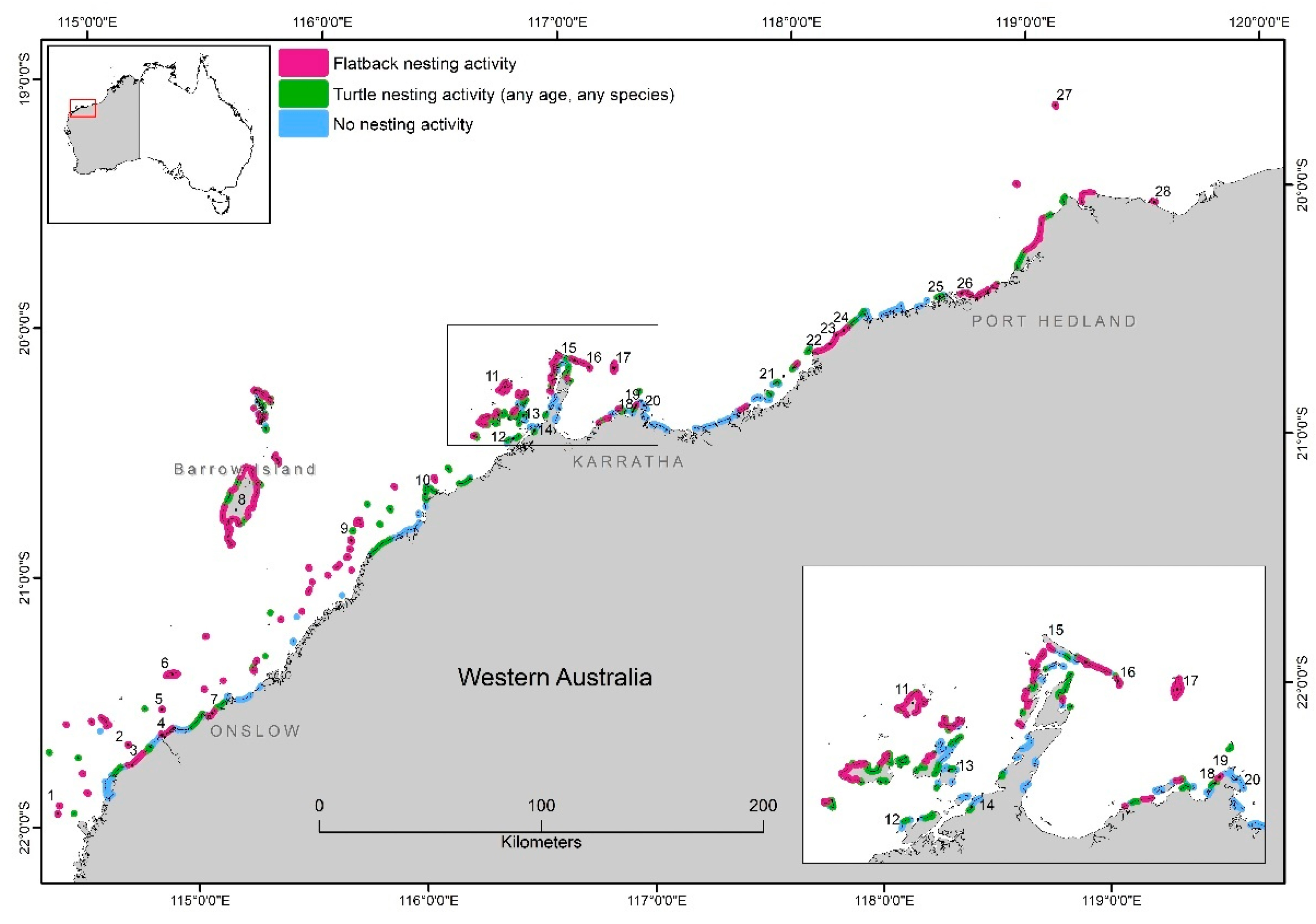
Distribution of turtle nesting activity in the North West Shelf of Western Australia, compiled from aerial surveys. Photo - DBCA
Research highlights

The NWSFTCP investigated the use of aerial photography as a tool for assessing the distribution and abundance of flatback turtles across a vast region, and for the identification of nesting beaches exposed to industrial development impacts. Aerial photos were taken every 0.33 seconds, covering 644 mainland beaches and offshore islands in the Pilbara region of Western Australia during peak nesting season. Researchers then separately reviewed each photo and identified beaches with turtle tracks or body pits (evidence of turtle nesting). The aerial tallies were validated with multiple ground surveys conducted at the same time.
Flatback turtle tracks were identified at 174 beaches, spread across 308 km of islands and the mainland, and identified the beaches with the greatest abundance as Delambre Island, Barrow Island and Mundabullangana. Overlapping locations of industrial and protected sites showed that a third of all flatback turtle nesting beaches were located within 5 km of at least one major industrial site, and almost all (97 per cent) were located within 50 km of major sites. Positively, 77 per cent of flatback nesting beaches were located within protected areas. Assessing the location of high abundance rookeries and unprotected beaches is important for the future management and monitoring of this population.
This research was led by DBCA/NWSFTCP.
Erosion and inundation of sandy beaches is a key threat to marine turtle populations globally. During extreme weather, high tides and waves can flood nests, either drowning eggs or heightening the risk of fungal infection. Sand is also eroded from the beach which reduces habitat for nesting.
An assessment of the coastal vulnerability of flatback turtle nesting sites in the Pilbara found that 36% of the most abundant nesting beaches used by flatback turtles had high exposure to erosion and inundation, indicating that this is a significant threat to the reproductive success of this stock. Nesting sites on small, flat islands are most vulnerable, while larger islands are most resilient. Understanding which beaches are resilient and which are most vulnerable to the effects of erosion and inundation under climate change scenarios enables conservation managers to plan for protection of resilient beaches, ensuring that turtles can access suitable nesting beaches into the future.
This research was led by The University of Western Australia’s Oceans Institute, in collaboration with DBCA/NWSFTCP.
As the sex of hatchlings and their likelihood of survival is dependent on the temperature of their nest, an understanding of how a warming climate will affect nest temperatures is critical. Previous studies have shown a decline in emergence success from nests with sand temperatures above 31°C, while mostly females are produced from warmer nests.
Researchers predicted hourly sand temperatures at 402 flatback turtle nesting beaches across Western Australia’s Pilbara region. The average sand temperatures were predicted for three climate change scenarios at 10 of these beaches: the “current” climate (1986 – 2015 average); and two future scenarios where average air temperature was 2°C or 4°C higher.
Under the current climate, hatchling emergence success averages 76% across modelled sites. As air temperature (and therefore nest temperature) increases, emergence success is predicted to decrease to 63% (2°C) or 37% (4°C). Expected outcomes are not uniform however, and some cooler beaches will continue to support male production under future warming climates. By triaging Pilbara beaches into three management categories – protect, monitor and mitigate – this research enables the prioritisation of strategies for the management of flatback turtle nesting beaches depending on their future thermal risk.
This research was led by The University of Western Australia’s Oceans Institute, in collaboration with DBCA/NWSFTCP, The University of Western Australia’s School of Biological Sciences and The University of Massachusetts Amherst.
Publications
2024
2023
2021
2020
Researchers

Dr Scott Whiting
Principal Research Scientist

Dr Sabrina Fossette
Senior Research Scientist

Dr Tony Tucker
Senior Research Scientist