Home
Home Search
 Contact


Managing multiple threats at once
The North West Shelf flatback turtle stock faces numerous threats, with many of these overlapping and resulting in cumulative impact. To effectively maintain turtle stocks, it is essential to understand how many threats are present at nesting and feeding areas, and how to prioritise conservation options.
What we know so far
Research on cumulative threats has focused on the identification of threats within a specified area and how to prioritise conservation intervention options where more than one threat or solution exists. The identification of multiple threats has occurred on a small scale (for example, at different points along the same beach in Thevenard Island), medium scale (for example, in ‘nursery’ areas of flatback hatchlings), and at large scale across North-Western Australia. A process for prioritising conservation intervention options has been developed to address uncertainty around which interventions to proceed with for the greatest conservation outcomes.
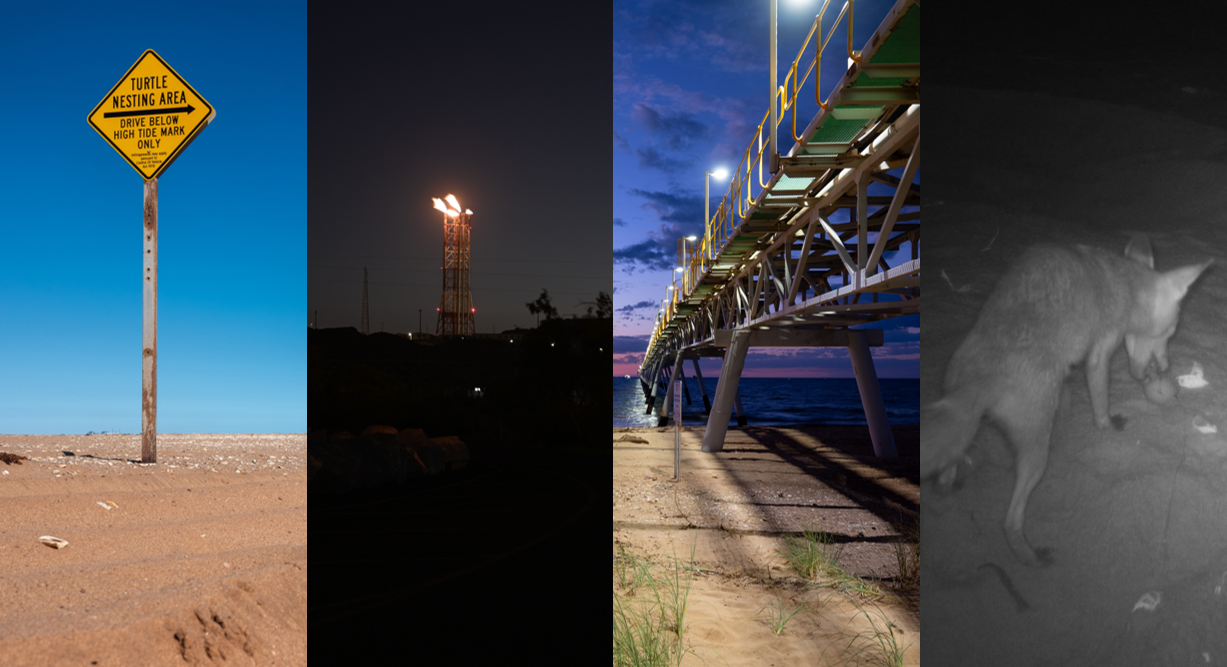
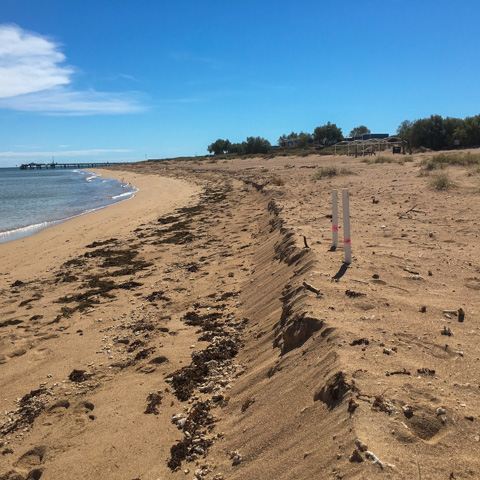
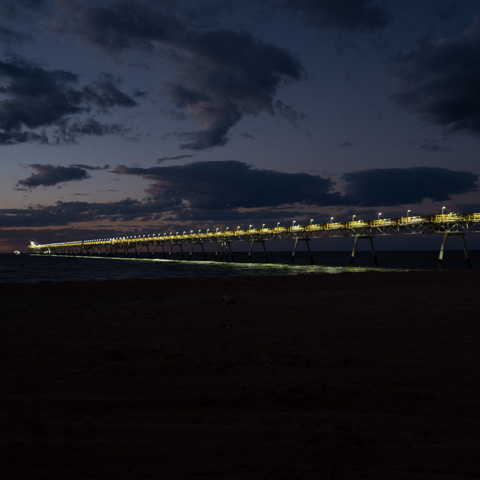
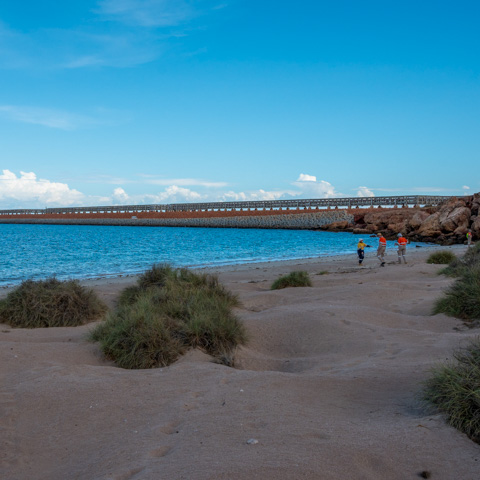
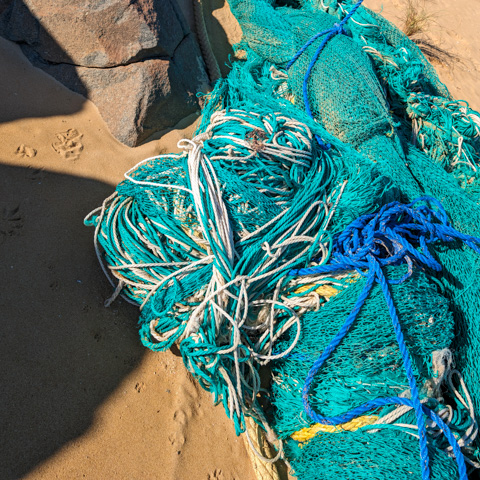
Examples of threats faced by flatback turtles, including driving on nesting beaches, coastal development and associated artificial light, and predation. Photo - Tristan Simpson/DBCA
Research highlights

A range of conservation intervention options to maintain or increase future flatback turtle stocks were presented to experts and members of the public. Experts used an Intervention Prioritisation Tool (IPT) to prioritise each intervention based on their economic cost, implementation feasibility, social acceptability, and perceived effectiveness. Members of the public engaged with a Social Acceptability Survey (SAS) to verify the experts’ assessments and understand community perceptions.
It was found that interventions that protected hatchlings on their way to the water (such as nest guarding) or reduced the threat posed by introduced animals were the lowest risk (i.e. have low cost, high social acceptability, and high implementation feasibility). Interventions that were rated highly feasible by experts were sometimes rated low for social acceptability, highlighting interventions where community education and communication is important. Results from these surveys can be used to inform community engagement and resolve uncertainty around which interventions to proceed with for marine conservation programs.
This research was led by CSIRO, in collaboration with DBCA/NWSFTCP, University of Tasmania and University of New South Wales.
North-Western Australia is a large and remote area that is subject to multiple human activities, presenting a challenge for assessing the potential impacts of these activities to a range of species. Researchers addressed this issue by compiling satellite telemetry data from multiple studies of marine turtles, whales, and sharks and overlaying species’ distributions with areas of coastal modification, vessel strike, underwater noise, oil spill, bycatch, entanglement, and artificial light.
The results showed that areas of high exposure to threats, such as the Ningaloo and Pilbara regions, included ecologically important sites for all species. All species’ distributions within the study overlapped with threats, and even areas with existing protections were experiencing high levels of threat exposure. Importantly, a robust approach was developed for documenting the potential exposure of marine species to a range of human activities at appropriate spatial scales to inform conservation management.
This research was led by Australian Institute of Marine Science as part of the NWSS Program supported by Santos. The research was conducted in collaboration with DBCA/NWSFTCP, The University of Western Australia, Department of Climate Change, Energy, the Environment and Water TAS, Flinders University, Macquarie University, Centre for Whale Research WA, Universidade de Santiago de Compostela, Light Pollution Science and Technology Institute, Charles Darwin University, Conservation Volunteers Australia, Murdoch University, ECOCEAN, Pendoley Environmental, University of Queensland, Rio Tinto, and Environmental Resources Management Pty Ltd.
Little is known about where flatback hatchlings go during the first few months of their life, with knowledge of their behaviour for this time being almost impossible to obtain with existing technology. As hatchlings are too small to be tracked using satellite telemetry, researchers used a particle tracking model to predict areas where early life stage flatback turtles are most likely to be found. The results were then overlapped with two identified threats for hatchlings: in-water artificial infrastructure and artificial light.
The results showed that most of the core area used by flatbacks during early dispersal (days 1-4 and 10-15) contained at least one of the two threats, while less than half of the area used between day 25-30 was exposed to threats. These results can be used to guide future management and conservation of flatback turtle hatchlings.
This research was led by the Australian Institute of Marine Science in collaboration with DBCA/NWSFTCP, The University of Western Australia and Pendoley Environmental.
Do nearshore structures such as jetties pose a threat to marine turtles? In this study, researchers compared predation levels of hatchling flatbacks at two nesting beaches with similar nesting activity; one near a jetty and one without any nearshore structures. Hatchlings were equipped with very small acoustic transmitters to track their movements as they left the beach. The results revealed that around 70% of the tagged hatchlings at the site near the jetty were predated before they could transit through the nearshore waters, while between 3-23% of hatchlings were predated at a site with no nearshore structures.
By providing daytime refuges, nearshore structures such as jetties can concentrate predators and may pose a significant threat to populations of vulnerable species. This must be considered when assessing the environmental impacts associated with these structures.
This research was led by The University of Western Australia and the Australian Institute of Marine Science, in collaboration with DBCA/NWSFTCP and Pendoley Environmental.
Publications
Researchers
Dr Scott Whiting
Principal Research Scientist
Dr Sabrina Fossette
Senior Research Scientist

Dr Tony Tucker
Senior Research Scientist