Home
Home Search
 Contact


Understanding the impact of light pollution on hatchlings
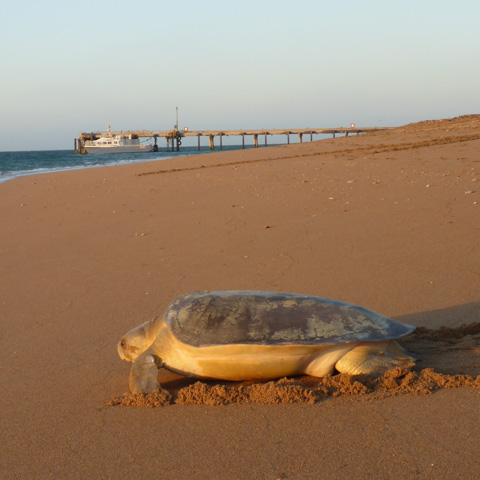
Once emerged from the nest, turtle hatchlings orientate to the lightest horizon which usually guides them to the sea. The attraction to light is complex and is a combination of intensity (strength) and wavelength (colour of the light). Artificial light is present at many rookeries both near the beach and on the water, which has the potential to cause misorientation or disorientation in hatchlings and decrease the odds of survival. Knowledge of how light influences turtles means that managers can improve conservation of turtles by reducing light sources, shielding lights or changing their colour to the red spectrum.
What we know so far
Research has focused on the effects of artificial light during the in-water dispersal period (when hatchlings enter the ocean and move to deeper water). The use of acoustic telemetry to track movements and behaviours has been utilised to assess this in hatchlings. Evidence has shown that light pollution has a negative impact on hatchling speed, direction of travel, and time spent in nearshore waters during their dispersal.
Much of the research completed by the NWSFTCP and its partners has been contributed to the National Light Pollution Guidelines for Wildlife 2023, which aims to raise awareness of the impacts of artificial light on wildlife and with implementation reduce the risk. Adherence to this document is now widely required under environmental approvals for any development with artificial light that may impact marine turtle and other species.
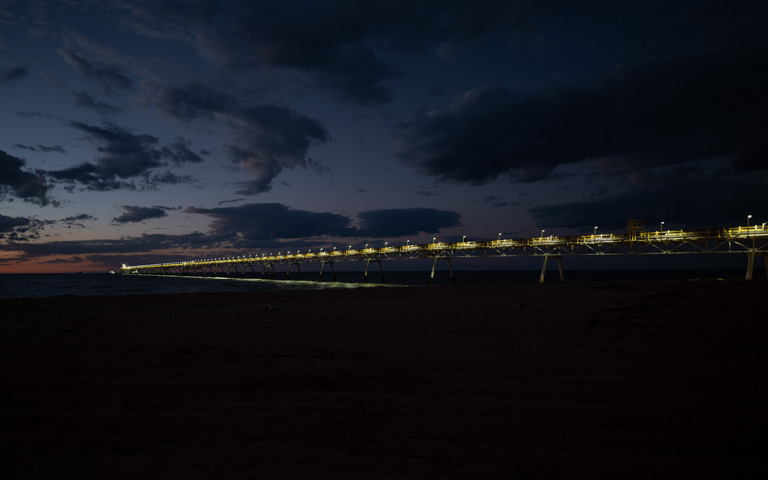
An example of artificial light from a jetty at Back Beach, Onslow. Photo - Tristan Simpson/DBCA
Research highlights

The investigation of in-water movement of sea turtle hatchlings has historically been difficult due to their small size in comparison to the size of tracking technology. As a result, much of what we know about their in-water movement has come from visual tracking, and mostly during the day. By collecting data during the day, hatchlings may be subject to the ‘observer effect’ and not act naturally. In addition, daytime tracking does not represent natural conditions as hatchlings usually emerge from their nests and enter the water at night. Advancements in technology have meant that much smaller transmitters are now available, overcoming these limitations and allowing researchers the ability to track natural in-water behaviour.
By applying the smaller acoustic transmitters, researchers tested the use of this technology to assess the impacts of light pollution on turtle hatchlings during their ‘frenzy period’ (24 – 48 hours after they enter the surf from the beach) when they swim quickly offshore to escape predators. Extreme weather hampered the experiment and the results on the impact of light pollution were inconclusive; however, the method was shown to have great potential to understand the in-water behaviour of turtle hatchlings in the future.
This research was led by The University of Western Australia’s Oceans Institute, in collaboration with the Australian Institute of Marine Science, DBCA/NWSFTCP, Pendoley Environmental, Macquarie University, and Charles Darwin University.
What effects do artificial lights have on flatback turtle hatchlings? Using acoustic telemetry, researchers tracked hatchling movements during their nearshore dispersal at locations both with and without sources of artificial light. The results showed that artificial light reduced the hatchlings’ swim speed by up to 30%, increased the amount of time spent in nearshore waters by 50 to 150% and increased the variance in bearing regardless of oceanographic conditions. Overall, the presence of artificial light caused hatchlings to linger, become disoriented and expend energy swimming against ocean currents.
This research was led by The University of Western Australia and the Australian Institute of Marine Science, in collaboration with DBCA/NWSFTCP and Pendoley Environmental.
As LEDs begin to replace traditional lights, it is important to understand if different brightness levels influence hatchling dispersal and predation levels at sea. To test this, researchers used acoustic telemetry to track hatchlings during their in-water dispersal while exposed to a range of lights with different intensities ranging from 10w to 120w.
The results suggest that if LEDs are placed in a different location to where hatchlings would usually disperse offshore to then the direction they swam would vary, with a change in direction being observed at the highest light intensity. There was weak evidence suggesting predation levels change with light intensity, and no relation was found between hatchling speed and time spent in the tracking area with light intensity. There is the possibility that a small sample size affected the ability to detect real effects, and further research is recommended to increase confidence in the findings.
This research was led by The University of Western Australia and the Australian Institute of Marine Science, in collaboration with Pendoley Environmental and DBCA/NWSFTCP.
Publications
2025
2022
2018
2013
Researchers

Dr Scott Whiting
Principal Research Scientist

Dr Sabrina Fossette
Senior Research Scientist